Email:eshop@aaeon.com

Language

Autonomous Mobile Robots (AMRs) are robots that can perform tasks and independently navigate various environments by assessing and responding to their surroundings in real-time and without assistance from personnel. There are several key features that distinguish AMRs from similar technologies such as autonomous guided vehicles (AGVs), primarily with respect to the dynamic nature of how AMRs operate when compared to their pre-programmed counterparts.

AMRs deploy various mapping and localization models, such as Simultaneous location and mapping (SLAM) to interpret their surroundings.

AMRs utilize a combination of firmware and peripheral devices such as sensors, cameras, processing units, and actuators to move, analyze data, and execute tasks.

To identify objects, make decisions, and react to outside stimuli, AMRs rely on sophisticated AI algorithms deployed on the edge, as opposed to the cloud. This ensures minimal latency.

AMRs have been deployed across a range of industries, undertaking tasks that streamline the efficiency, safety, and productivity of business operations.
With the adoption of edge AI solutions increasing across sectors, many new technologies can be harnessed to streamline workflows, increase efficiency, and enhance the effectiveness of existing healthcare tools. Such examples include:

As opposed to AGVs, AMRs do not rely on pre-planned pathways, allowing for tasks and movements to be completed in the most efficient manner according to the scenario.

AMRs can operate independently, reducing the need for investment to integrate them into existing infrastructures. Meanwhile, AAEON's hardware includes common communication protocols that are compatible with legacy systems.

AMR hardware can be ruggedized to ensure reliable operation in harsh environments, such as power plants, factories, and the outdoors. This, along with their small size, allow tasks such as quality inspection in tight spaces possible without human personnel.

AMRs reduce personnel costs by enabling tasks to be delegated, while increasing the speed with which tasks can be completed. Higher accuracy and the elimination of human error also reduces product defect rates.

Autonomous Mobile Robots (AMRs) need systems that can run advanced AI models and algorithms to perform effectively in complex environments. These systems must handle perception, decision-making, and action execution in real-time.
Accurate localization and mapping (SLAM) in complex, GPS-denied environments present significant challenges that must be overcome for AMRs to operate effectively.

Autonomous Mobile Robots (AMRs) often operate in environments with extreme temperature variations, like power stations, assembly lines, or outdoor settings, which significantly impact their design, operation, and maintenance.
Many industrial organizations adopt AMR technology to eliminate human risks in hazardous, confined spaces, making compact and lightweight designs essential.

Modifying existing machinery and infrastructure for AMR compatibility can be expensive, involving physical changes, software upgrades, and personnel training.
AMRs often need to interact with existing machinery like conveyor belts or loading docks. Design or dimension mismatches can hinder these interactions, requiring modifications to either the AMRs or the infrastructure.


AAEON delivers industrial-grade edge AI platforms designed to overcome the challenges of autonomous mobile robot deployment. From real-time AI computing to rugged reliability and flexible expansion, our solutions help accelerate AMR development across diverse industries.

High-performance edge AI platforms designed to accelerate AI inference, computer vision, perception, and real-time decision-making for autonomous mobile robots.

Designed for demanding environments, AAEON's fanless, industrial-grade systems support wide operating temperatures and continuous operation in factories, warehouses, logistics centers, and outdoor applications.

Support diverse AMR applications with rich industrial I/O and flexible expansion for cameras, LiDAR, radar, CAN Bus, Ethernet, wireless communication, and additional peripherals.

From compact embedded boards to high-performance edge AI systems, AAEON offers a comprehensive portfolio that helps shorten development time and supports long-term deployment for various AMR applications.


◆ CPU
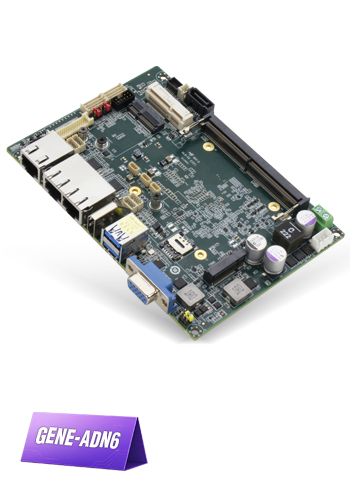
The Intel Core i3-N305, Intel Atom x7425E, or Intel Processor N-series platform offers the computational power needed for real-time data processing, complex algorithms, and decision-making tasks while maintaining power efficiency, extending battery life and reducing costs.

◆ Compatibility
Multiple communication interfaces such as RS-232/422/485, GPIO, and SMBus allow for broad compatibility with legacy equipment.

◆ Rugged Design
A -20°C to 70°C (-4°F to 158°F) temperature range and 9V to 36V power input tolerance allows the board to be deployed in harsher environmental conditions.

◆ Audio Interface
The board's Line-In/Line-Out/Mic interface makes it particularly suited to retail usage, where it can provide a more interactive customer experience.


◆ AI-Integrated SoC
The Intel Core Ultra platform offers an integrated CPU, GPU, and NPU for up to 32 TOPs of inference performance. The addition of Intel Arc graphics enhances the real-time video processing capacity of the board for higher resolution image acquisition for real-time edge processing.

◆ Power Efficiency
The UP Xtreme i14 has an extremely high performance to power consumption ratio, along with its wide 9V-36V power input allowing flexibility for integration with various battery configurations.

◆ MIPI Camera Support
Due to its high resolution, frame rates, and bandwidth, MIPI camera support allows for more detailed image data to be obtained, leading to more accurate output. The interface is also low in both power consumption and latency, providing benefits in both practicality and performance.

◆ Raspberry Pi-Compatible 40-pin Header
The board provides a versatile set of peripheral connections all in one 40-pin header, including GPIO, UART, I2C, SPI, and time synchronization pins, making it incredibly versatile for AMR development.

Security Patrol AMRs enhance safety and security in retail stores, government buildings, and airports. These robots autonomously patrol premises, monitor for unusual activities, and provide real-time alerts to security personnel.


◆ NVIDIA Jetson AGX Orin
275 TOPS of AI performance alongside the 2048-core NVIDIA Ampere architecture GPU with 64 Tensor Cores for world-leading inferencing on the edge.

◆ Communication
Equipped with a range of serial communication ports, including DB-9 connectors for CANBus and RS-232/485 interfaces. This versatility in serial communication supports integration with a broad array of sensors and devices.

◆ GMSL2 Camera Support
Real-time video streaming from multiple high-definition cameras over longer distances without signal degradation, which is essential for monitoring and navigation in dynamic environments.

◆ Environmental Durability
Wide 9V to 36V Power input range with ignition delay on/off funciton, MIL-STD-810G shock and vibrationn tolerance, and a wide -25°C to 65°C temperature range allows operation in harsh settings.

Multipurpose outdoor AMRs can be deployed in harsher environments for the purposes of construciton site surveying, materials handling, and emergency response efforts where it is unsafe for human personnel.





